
How the association is governed
The Essex Crossing at Montserrat Homeowners Association is a Massachusetts trust covering the 16 single-family lots on Pond View Lane. Everything on this page comes from the recorded instruments — the citations open them at the page.
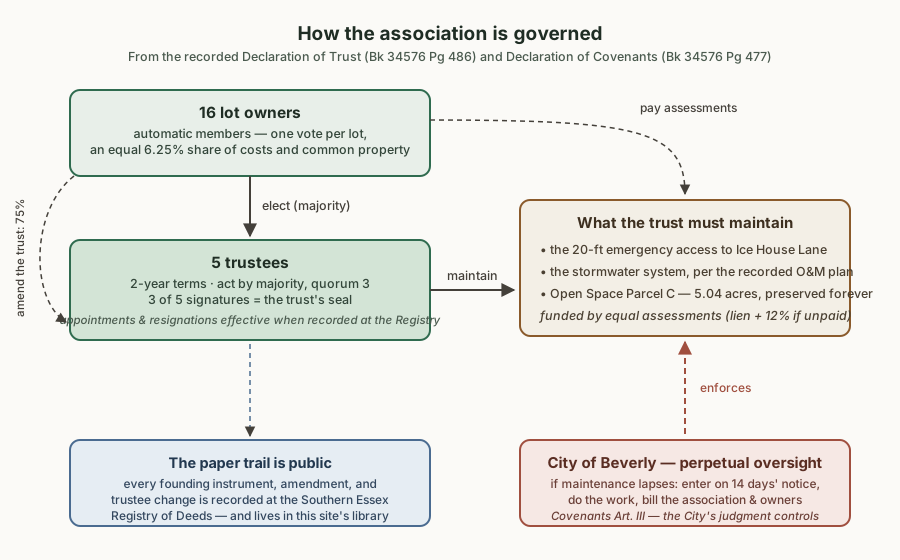 A drawing of the structure the recorded instruments create — the trustee
board from Trust Art. IV, pp. 5–6,
the maintenance duties from
Covenants Art. II, pp. 3–4,
the City’s enforcement power from
Covenants Art. III, pp. 6–7,
and the recording requirement from
Trust, p. 6. Each of those
instruments can be pulled independently from the
Southern Essex District Registry of Deeds.
A drawing of the structure the recorded instruments create — the trustee
board from Trust Art. IV, pp. 5–6,
the maintenance duties from
Covenants Art. II, pp. 3–4,
the City’s enforcement power from
Covenants Art. III, pp. 6–7,
and the recording requirement from
Trust, p. 6. Each of those
instruments can be pulled independently from the
Southern Essex District Registry of Deeds.
Membership and votes
Section titled “Membership and votes”- Owning a lot automatically makes the owner a beneficiary of the trust. There is no opting out, and membership can’t be sold separately from the house (Trust, p. 4).
- One vote per lot, each lot an equal 6.25% share of the common property and expenses (Trust schedule, p. 23). Co-owners share one combined vote.
The five trustees
Section titled “The five trustees”- Owners elect 5 trustees to 2-year terms; they act by majority vote with a quorum of 3 (Trust Art. IV, pp. 5–6).
- Trustees may name a Chair, Treasurer, and Secretary among themselves.
- Vacancies are filled by a written instrument signed by 50% of owners and recorded at the Registry; a court can appoint if a seat sits empty more than 60 days (Trust, p. 5).
- Resignations take effect when recorded. That’s why the Trustee Instruments section of the library is the public paper trail of the board’s recorded changes — appointments and resignations are registry documents (Trust, p. 6).
- The recorded chain has a gap (as of 2026). Every board change through 2021 is on file, but the trail ends there: the most recent recorded change is a resignation on 11/19/2021 (Bk 40504 Pg 495), and no appointment has been recorded since 12/6/2019. The 2022 appointment that filled the seat vacated in 2021 does not appear at the Registry, so the public record currently documents four of the five sitting trustees. Because the trust says an appointment “takes effect when recorded,” that seat’s current trustee isn’t reflected in the recorded chain until the instrument is filed.
- Trustees are liable only for their own “willful malfeasance and default” and are indemnified from trust property (Trust, p. 6).
Meetings
Section titled “Meetings”- Annual owners’ meeting: first Monday of November, 7:30 p.m., with 14 days’ notice (Trust, p. 13).
- Owner quorum is 50% of lots; owners holding more than half the votes can call a special meeting (same page).
What the association must maintain
Section titled “What the association must maintain”The master covenant assigns the association, exclusively (Covenants Art. II, pp. 3–4):
- The subdivision’s roadways, as the covenant was written — the 2015 text assigns “the road ways in the subdivision, including Pond View Lane.” The lane itself, though, has since been accepted as a public way: the City maintains and plows the street and runs collection on it (it appears on the City’s collection routes, and the MassDOT Road Inventory lists Pond View Lane as city-maintained). What stays the association’s under this clause is the 20-foot-wide emergency access and utility easement running from Pond View Lane all the way to Ice House Lane — the recorded covenant names it the “Emergency 20’ Wide Access & Utility Easement,” so the 20 feet is its width, not its length. The recorded plan (Plan Book 446 Plan 73) draws it as a curved way about 80 feet long where it crosses the common parcel. It must be kept free of all obstructions (vehicles, snow, overgrown brush).
- The stormwater management system, per the recorded O&M plan — see Stormwater.
- Open Space Parcel C (5.04 acres of woods and wetland) and its trails — see The common land.
- The walls the covenants’ maintenance article assigns to it (same citation).
- Mailboxes and mailbox posts — added to the trust’s purposes by the recorded First Amendment (2016), which also provides the City bears no liability for mailbox damage, including from snow plowing or sanding.
Rules on each lot
Section titled “Rules on each lot”The Restrictive Covenants run with every lot until about 2045 — the instrument sets its own 30-year term and provides for extension “for successive periods of ten years” unless a majority of owners record an instrument changing or terminating it (¶10). Thirty years is also the statutory ceiling Massachusetts puts on restrictions written without a time limit (M.G.L. c.184 §23; the mechanics of extending one are at §27). The highlights, from the recorded text:
- Architectural control — no structure, fence, or exterior alteration without written approval; work completed within one year of approval (¶¶1–2).
- Single-family use only; a home office is allowed with at most one employee, but no other business operation (¶3F).
- No clotheslines; antennas and dishes placed out of street view; solar panels on the rear only, not visible from the street (¶3B).
- Fencing only behind the front wall of the house; a side-run fence at most 4 feet and not chain-link (¶3N).
- Pets leashed or restrained, waste picked up daily; no kennels or livestock (¶3G).
- Boats and trailers stored behind the house; unregistered vehicles in the garage (¶3I). Trash containers screened to the rear (¶3H).
- Signs no larger than 6″ × 25″, except for-sale signs and signs required by a Conservation Commission order (¶3J).
- Grass trimmed, hedges pruned, structures kept in good repair (¶3K); no nuisance activity (¶3L).
- Drainage and utility easements on the lots are perpetual: nothing may be placed in them that changes drainage flow, and the owner maintains the easement area (¶6).
- Enforcement now belongs to the owners: with the developer gone, any lot owner may enforce the restrictions, and more than half of the owners together may grant a waiver or variance (¶¶4, 12).
Changing the rules
Section titled “Changing the rules”- Amending the trust takes 75% of owners, in writing, recorded (Trust Art. VIII, p. 17) — and the trust can’t be amended to dodge a Planning Board condition without the City’s written consent (p. 20).
- The one recorded amendment so far is the First Amendment (executed by the developer as sole trustee, recorded 9/16/2016 at Bk 35266 Pg 467) — the mailbox provision described above (the amendment).
The City’s permanent seat at the table
Section titled “The City’s permanent seat at the table”Essex Crossing is an Open Space Residential Design (OSRD) subdivision — permitted under what is now § 300-54 of Beverly’s zoning ordinance, which the City describes on its OSRD page — and the City of Beverly retains oversight in perpetuity: if the association lets required maintenance slide, the City may enter on 14 days’ notice, do the work, and bill the association and owners — with the City’s own judgment controlling whether the work was necessary, backed by a $3,000 bond (Covenants Art. III, pp. 6–7).